Conference Room Ventilation
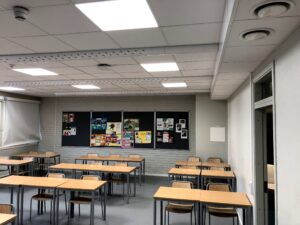
Conference rooms can go from being empty to being filled with many people in just a few minutes. This creates rapid changes in both heat load and the need for fresh air. The ventilation must therefore be able to supply large airflow rates efficiently without people sitting near the supply air diffuser being exposed to drafts or large temperature differences.
A scientific study from the University of Gävle and Linköping University shows how the design of a supply air diffuser with confluent jets affects air quality, heat removal, and thermal comfort in conference rooms. The results show that it is not only the total airflow rate that matters. The number of nozzles, their placement, and the total outlet area affect how the air reaches and is used in the occupied zone.
Conference rooms place special demands on ventilation
The occupancy load in a conference room often varies significantly more than, for example, in a single office room. When a meeting begins, both the carbon dioxide level and heat emission increase rapidly. Computers, monitors, lighting, and other technical equipment can simultaneously contribute additional heat.
The ventilation solution therefore needs to be able to:
- supply sufficient fresh air at full occupancy
- remove heat from people and technical equipment
- limit the risk of drafts in the seated occupied zone
- function at both low and high airflow rates
- provide even and controlled air distribution
- integrate with demand-controlled ventilation
Since participants usually sit still for longer periods, even relatively low air velocities can be perceived as disturbing. This is especially true around the feet and ankles, where low-placed or downward-directed air currents can cause local thermal discomfort.
What is confluent jets ventilation?
Ventilation with confluent jets is called confluent jets ventilation, abbreviated CJV, in English. The technique is based on introducing supply air through several smaller nozzles placed close to each other.
Each nozzle creates a separate air jet. A short distance from the diffuser, the air jets begin to merge, forming a larger, continuous airflow. By distributing the airflow rate over many nozzles, the outlet velocity from each opening can be limited while a large total airflow rate is supplied to the room.
The number, placement, and direction of the nozzles affect, among other things:
- the velocity and throw of the air jets
- how quickly the supply air mixes with the room air
- the temperature in the occupied zone
- the mean age of air in different parts of the room
- the ability to transport away excess heat
- the risk of drafts near the floor
This means that the design of the nozzle matrix is a central part of the supply air diffuser’s function.
Research on ventilation with confluent jets in conference rooms
In the study A Numerical and Experimental Investigation of a Confluent Jets Ventilation Supply Device in a Conference Room, Harald Andersson, Mathias Cehlin, and Bahram Moshfegh investigated how three different nozzle configurations performed in a conference room environment.
Harald Andersson was at the time an industrial doctoral student affiliated with Repus. The study was conducted at the University of Gävle and Linköping University and published in 2022 in the scientific journal Energies.
The researchers compared supply air diffusers with three different nozzle matrices:
- one row with 19 nozzles
- two rows with a total of 38 nozzles
- three rows with a total of 57 nozzles
The diffusers were examined under two different combinations of airflow rate and supply air temperature. The study combined practical measurements with numerical CFD calculations to analyze air velocities, temperatures, and air movement in the room.
Performance was assessed based on three key areas:
- thermal comfort
- air quality in the occupied zone
- efficiency of heat removal
By comparing the measurement results with several turbulence models, the researchers could also assess which calculation model best reproduced the actual airflow rate.
Nozzle matrix size affected the entire room’s air distribution
The results showed that the size of the nozzle matrix had a significant impact both near the supply air diffuser and further out in the occupied zone.
When the same airflow rate was distributed over several nozzles and several rows, the velocity through each individual nozzle was lower. The diffusers with two or three nozzle rows therefore had lower momentum than the diffuser with only one row.
The larger nozzle matrix better preserved the properties of the supply air on its way into the occupied zone. It also provided a more favorable distribution of the mean age of air, meaning that the fresh supply air was used more effectively where people were present.
The study thus shows that a larger number of nozzles not only changes the conditions immediately in front of the diffuser. The design also affects the air quality and temperature distribution in the rest of the room.
Multiple nozzle rows provided better air quality
According to the numerical results, the diffusers with multiple nozzle rows provided better air quality in the occupied zone than the diffuser with a single nozzle row.
An important explanation was that the larger supply air area and lower velocity resulted in a more advantageous transport of fresh air. The supply air could retain its properties longer and reach the occupied zone without mixing as quickly with older room air near the diffuser.
For a conference room, this is particularly relevant. When many people are in a confined space, the supplied air not only needs to enter the room but also to be effectively distributed where participants are seated.
The study therefore demonstrates the value of designing the entire air distribution, not just the total airflow rate.
More efficient heat removal from the occupied zone
The diffusers with a larger nozzle matrix also showed higher efficiency for heat removal. The lower supply air velocity allowed the thermal driving forces in the room to contribute more to air movement.
Warm air from people and technical equipment naturally rises. When supply air is introduced at the correct velocity and air distribution pattern, this temperature-driven airflow can help to move heat upwards and away from the occupied zone.
The results show that the interaction between the supply air diffuser and the room’s natural air movements is significant. Higher outlet momentum is not automatically better. How the air is supplied can be as important as how much air is supplied.
Lower air velocity reduced the risk of drafts at ankle level
A central comfort issue in conference rooms is the risk of drafts around the legs and feet. Participants often sit still during longer meetings and can therefore be particularly sensitive to local air currents.
In the study, the diffusers with multiple nozzle rows resulted in lower air velocities at ankle level than the diffuser with a single row. The lower velocity reduced the risk of drafts and local thermal discomfort.
The result illustrates an important design principle: when an airflow rate is distributed over a larger outlet area, the velocity from each nozzle can be reduced. This creates better conditions for supplying the necessary air volume without causing discomfort in the seated occupied zone.
What do the results mean for conference room design?
The study shows that the placement and number of nozzles need to be considered as active design parameters. The function of a supply air diffuser cannot be assessed solely based on connection size or total airflow rate.
When designing, consideration should be given to, among other things:
- room dimensions and ceiling height
- number of seats and expected occupancy load
- minimum and maximum design airflow rate
- supply air temperature
- the number of nozzles according to the current airflow rate
- diffuser placement in relation to seating
- number, direction, and outlet area of nozzles
- requirements for sound level and pressure drop
A supply air diffuser with multiple nozzles can provide good conditions for handling large airflow rates, but the diffuser must still be dimensioned for the specific room. The results from the study should therefore be seen as support for the technical principle, not as a guarantee that every nozzle diffuser will provide the same performance in all installations.
Nozzle ducts distribute air over a larger area
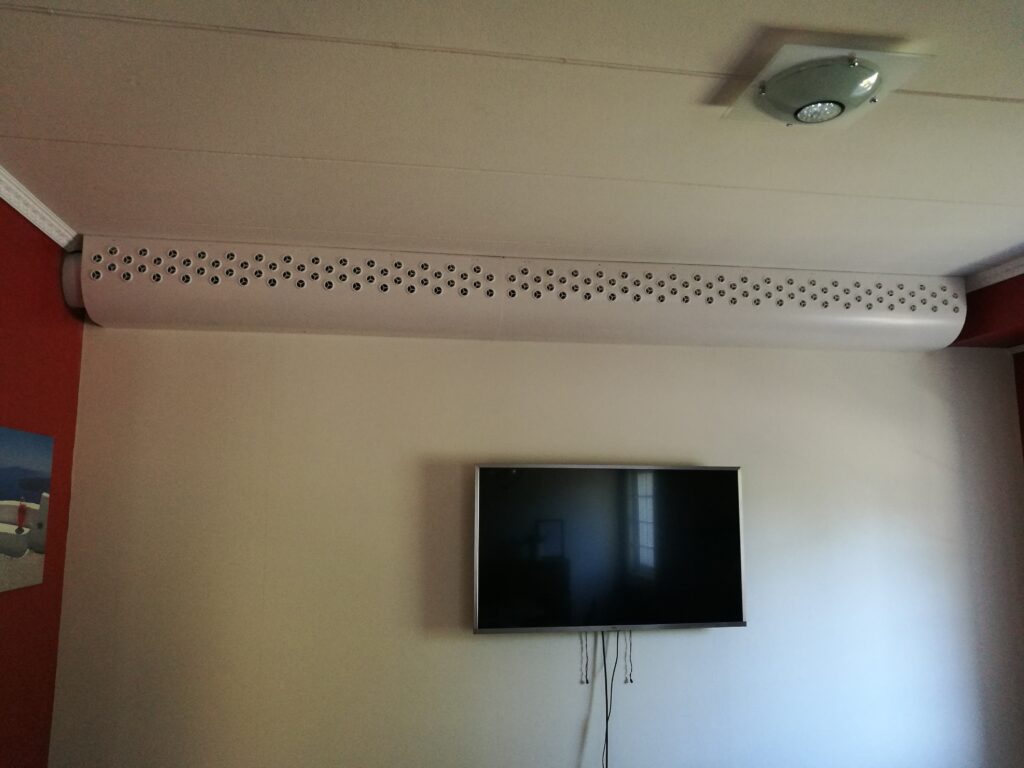
In a nozzle duct, the duct functions as both a transport path and an air distribution diffuser. Supply air is spread through many nozzles along the duct’s surface instead of being concentrated at a few separate supply air points.
This allows for adaptation of:
- the number of nozzles according to the current airflow rate
- the direction of the nozzles according to the room’s geometry
- the air distribution pattern according to furniture and occupied zone
- the length and dimension of the duct according to the installation
- design and color according to architectural requirements
For larger conference rooms, boardrooms, training facilities, and meeting rooms, this can create an even air distribution over an elongated or concentrated occupied zone.
Furthermore, a nozzle duct can reduce the need for separate branches and supply air diffusers. This can result in a more cohesive duct routing and a cleaner visual expression in premises with visible installations.
Customized supply air diffusers for various installation conditions
Not all conference rooms are suitable for the same type of supply air diffuser. Some premises have visible installations, while others have suspended ceilings or limited space for duct routing.
Repus manufactures both nozzle ducts and other types of supply air diffusers that can be adapted to the project’s conditions. Depending on placement and air distribution principle, the solution can, for example, be designed as:
- round or square nozzle duct
- surface-mounted ceiling diffuser
- wall-mounted supply air diffuser
- suspended ceiling integrated diffuser
- project-specific diffuser with customized dimensions and connections
By adapting the number, placement, and direction of the nozzles, the air distribution pattern can be designed based on the room’s use and furnishing.
Demand-controlled ventilation for varying occupancy
Conference rooms are often used irregularly. Designing the system for full occupancy but running the same airflow rate all day can lead to unnecessary energy consumption.
With demand-controlled ventilation, the airflow rate can be adjusted based on, for example, presence, carbon dioxide levels, or room temperature. For this to work well, the supply air diffuser needs to provide an appropriate air distribution pattern within the entire relevant flow range.
Repus nozzle ducts can be dimensioned for variable airflow rates. The placement and direction of the nozzles are adapted to the lowest and highest operating conditions of the premises, which creates conditions for efficient air distribution even when occupancy changes.
The 2022 study investigated two specific operating conditions and should not be interpreted alone as a complete verification of all VAV conditions. However, the results clearly show that the design of the nozzle matrix and the momentum of the supply air affect air quality, heat removal, and comfort.
Design Repus supply air diffusers in MagiCAD and Revit
For ventilation consultants, Repus products are available through design tools for MagiCAD and Revit. The products can thus be specified directly in drawings and digital models.
This simplifies the work of:
- selecting product and dimension
- placing the supply air diffuser in the model
- checking technical data
- coordinating the installation with other building components
- creating clear documentation for contractors and clients
For project-specific needs, Repus also assists with product selection, dimensioning, and adaptation of the air distribution pattern.
Are you planning ventilation for a conference room?
Repus helps ventilation consultants, contractors, and architects choose supply air diffusers based on room geometry, occupancy load, airflow rates, and installation conditions.
Please send a drawing or a short project description with the room’s dimensions, desired airflow rates, and the intended placement of the diffusers. We will respond with a proposal for a suitable solution.
Read more about Repus nozzle ducts
Contact us for design assistance
About the scientific study
The article A Numerical and Experimental Investigation of a Confluent Jets Ventilation Supply Device in a Conference Room was published on February 22, 2022, in Energies, Volume 15, Issue 5, Article 1630.
Authors: Harald Andersson, Mathias Cehlin, and Bahram Moshfegh.
The study was conducted at the University of Gävle and Linköping University and included both experimental measurements and numerical CFD calculations.
DOI: 10.3390/en15051630
Read the full scientific article at MDPI.