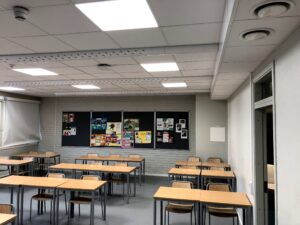

Nozzle ducts in school environments: effective air distribution for classrooms with varying loads
For schools, the choice of supply air principle involves more than just meeting a design airflow rate. The air also needs to be distributed effectively where students and teachers are located. Repus nozzle ducts are developed to distribute supply air over a large part of the room and can be adapted for both constant and varying airflow rates.
Classrooms require ventilation that functions at both high and low loads
A classroom can be full during one lesson and almost empty during the next. At the same time, students, teachers, lighting, and technical equipment contribute to both heat and pollutants in the indoor air.
The ventilation system therefore needs to handle several requirements simultaneously:
- supply sufficient fresh air to the occupied zone
- remove excess heat
- limit the risk of drafts
- provide good functionality at varying air flows
- keep pressure drop, noise levels, and energy use low
Increasing the airflow rate is not always enough. How the supply air is introduced and spread in the room is of great importance for the actual efficiency of the ventilation.
What is confluent jets ventilation?
Confluent jets ventilation, or CJV, is based on placing a large number of smaller air jets close to each other. When the jets leave the nozzles, they interact and form a common air stream.
The principle combines properties from mixing ventilation and stratified ventilation. Depending on the device design, airflow rate, supply air temperature, and the room’s heat load, the air distribution can be adapted to the conditions in the occupied zone.
In a nozzle duct, the supply air is distributed through many nozzles along the surface of the duct. This allows the air to be spread over a large part of the room instead of concentrating the entire airflow rate into a few traditional supply air diffusers.
Research on confluent jets in classrooms
In the scientific study On the Ventilation Performance of Low Momentum Confluent Jets Supply Device in a Classroom, Harald Andersson, Alan Kabanshi, Mathias Cehlin, and Bahram Moshfegh investigated three different supply air diffusers based on confluent jets.
The study was conducted in a classroom environment and published in 2020 in the scientific journal Energies. A conventional slot nozzle for mixing ventilation was used as a reference.
The researchers compared five operating cases with:
- supply air temperatures between 16 and 18 °C
- air exchange rates between 2.2 and 6.3 per hour
- heat loads between 17 and 47 W/m²
Performance was assessed based on thermal comfort, risk of drafts, air exchange efficiency, and the ability to remove heat from the occupied zone.
Results show advantages compared to mixing ventilation
Under the investigated conditions, the confluent jets systems exhibited better air quality and higher heat removal efficiency than the conventional mixing ventilation used for comparison.
The study also showed that the design of the supply air diffuser was of great importance. Devices with low momentum provided higher air exchange efficiency than the investigated high-momentum solution. The low-momentum variant with varying airflow direction also had 7 percent higher heat removal efficiency than the other CJV devices in the experiment.
The results emphasize that the placement of the nozzles, airflow direction, and outlet velocity all affect how effectively the air is used in the room.
At lower airflow rates, some of the investigated CJV devices created conditions similar to mixing ventilation. At higher flows, the temperature distribution became more stratified. The technology could thus react differently depending on the load and operating case, which is particularly interesting in premises where the occupancy load varies.
Why are the results relevant for school ventilation?
In demand-controlled ventilation systems, the airflow rate is usually adapted to, for example, occupancy, carbon dioxide levels, or temperature. For energy savings to be realized, the supply air diffusers need to function across the entire relevant flow range.
Nozzle ducts are well-suited for these types of premises because the air can be distributed through a large number of nozzles over a longer distance. This can provide several practical advantages:
Effective air distribution in the occupied zone
The supply air is spread from many points along the duct. This creates the conditions to reach a large part of the classroom and counteract areas with stagnant or insufficiently ventilated air.
Adaptation to varying airflow rates
School premises are rarely used with the same load all day. Repus nozzle ducts can be dimensioned for demand-controlled ventilation and varying airflow rates, known as VAV.
Short and controllable near zones
Through the correct choice of nozzles, nozzle placement, and airflow direction, the air distribution pattern can be adapted to the room’s geometry and furnishing. This is important in classrooms where students are located close to the supply air diffusers.
Possibility for project-specific design
Schools have different ceiling heights, floor plans, structural systems, and architectural conditions. Nozzle ducts can be adapted in terms of length, dimension, connection, color, and air direction.
Nozzle ducts can simplify both duct routing and air distribution
A traditional installation may require separate ducts, branches, and supply air diffusers to distribute air across the classroom. A nozzle duct functions as both a duct and an air distribution device.
This can reduce the number of visible components and create a more cohesive installation. In premises with visible installations, the nozzle duct can also become an integrated part of the room’s architecture. Color and design can be adapted to the project’s aesthetic requirements.
The exact system solution always needs to be dimensioned with consideration for, among other things, room dimensions, heat load, occupied zone, airflow rate, supply air temperature, sound level requirements, and duct placement.
Correct design is crucial for a good result
The study does not show that all devices with nozzles automatically provide the same performance. However, the results show that confluent jets ventilation has clear potential in classrooms and that the design of the device affects air quality, thermal comfort, and energy efficiency.
For each school project, the following factors therefore need to be weighed together:
- classroom dimensions and ceiling height
- minimum and maximum design airflow rate
- occupancy load and heat load
- supply air temperature
- nozzle direction and air distribution pattern
- placement in relation to students and teachers
- permitted sound levels and pressure drops
Repus helps ventilation consultants and contractors select and adapt nozzle ducts according to the project’s technical conditions. The products can also be designed using Repus tools for MagiCAD and Revit.
Swedish-made nozzle ducts for schools and educational premises
Repus manufactures nozzle ducts in Sweden and can adapt the products to both technical and architectural requirements. The solutions are suitable for classrooms, lecture halls, libraries, dining halls, and other educational environments where the load changes during the day.
By combining demand-controlled ventilation with well-thought-out air distribution, it is possible to create good air quality and thermal comfort while limiting the system’s energy use.
Are you planning ventilation for a school?
We help you dimension and select nozzle ducts based on the room’s airflow rates, geometry, load, and installation conditions. Please send a drawing or a short project description, and we will get back to you with a suitable product proposal.
Read more about Repus nozzle ducts
Contact us for design assistance
About the scientific study
The article On the Ventilation Performance of Low Momentum Confluent Jets Supply Device in a Classroom was published in 2020 in Energies, volume 13, issue 20, article 5415.
Authors: Harald Andersson, Alan Kabanshi, Mathias Cehlin, and Bahram Moshfegh.
DOI: 10.3390/en13205415